Grade 8 Bolts in Automotive Applications: Pros and Cons
Fasteners are one of the most overlooked components in automotive builds, yet they play a critical role in reliability and safety. One common question builders ask is whether Grade 8 bolts are suitable for automotive and performance applications.
At Fastime Performance in Taylor, Michigan, we work with engines, chassis, and drivetrain components every day. The short answer is yes — Grade 8 bolts can be used in automotive applications, but only when they are used in the right places and installed correctly.
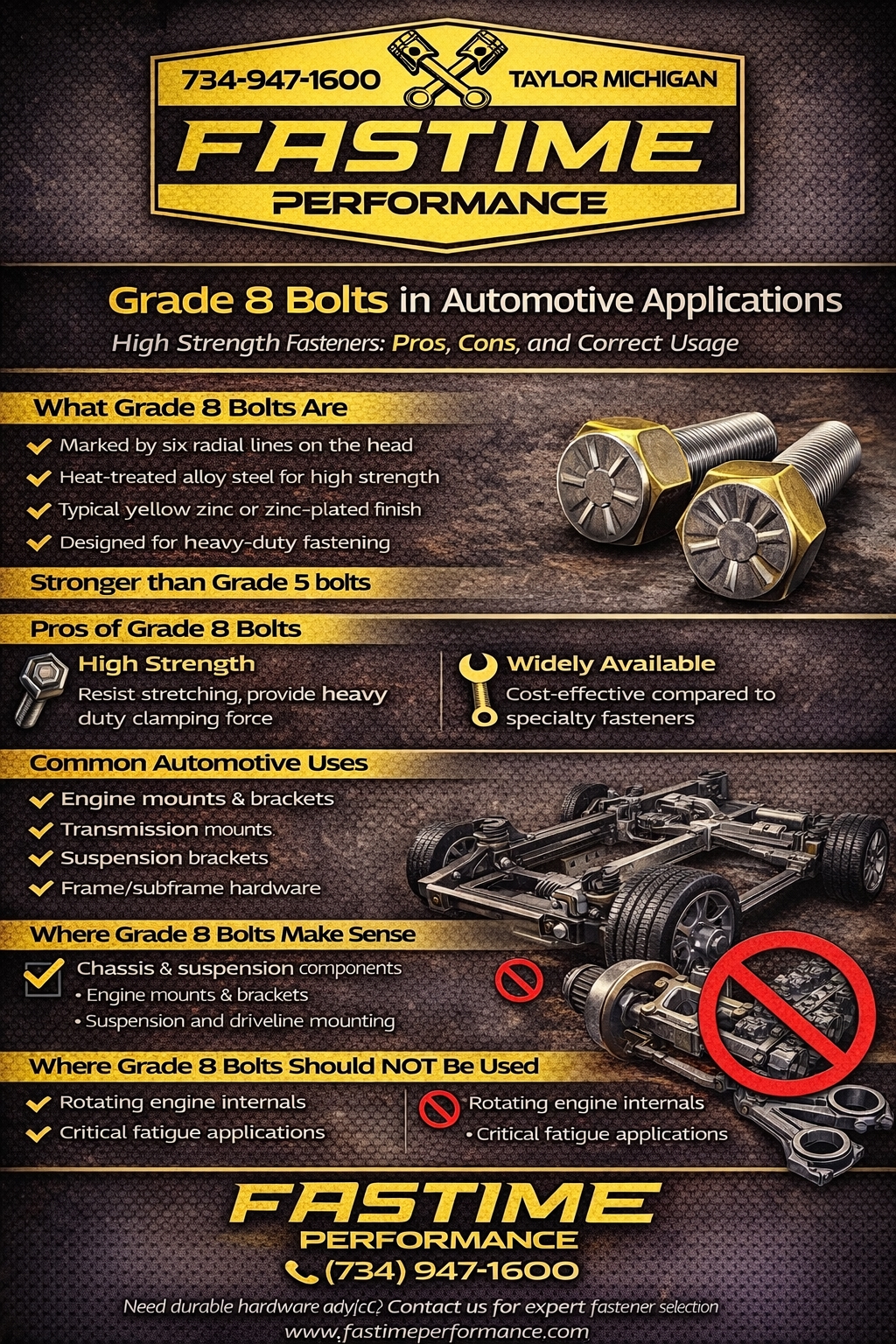
What Are Grade 8 Bolts?
Grade 8 bolts are high-strength fasteners identified by six radial marks on the bolt head. They are made from heat-treated alloy steel and designed to handle high clamping loads.
- High tensile and yield strength
- More strength than Grade 5 hardware
- Common yellow zinc or zinc-plated finish
- Designed for heavy-duty fastening
Pros of Using Grade 8 Bolts in Automotive Builds
High Strength and Load Capacity
Grade 8 bolts resist stretching under load and provide excellent clamping force, making them ideal for many chassis and mounting applications.
Good for Static or Low-Cycle Loads
In applications where the bolt sees steady load rather than constant stretch cycles, Grade 8 hardware performs very well.
Common Automotive Uses
Cons and Limitations of Grade 8 Bolts
Reduced Ductility
While very strong, Grade 8 bolts are less forgiving under vibration and cyclic loading compared to specialty fasteners designed to stretch.
Not Suitable for Engine Internals
Grade 8 bolts should not be used for critical engine components such as:
- Connecting rods
- Main bearing caps
- Cylinder heads
- Flywheels (unless specifically approved)
These locations require fasteners engineered for predictable stretch and extreme heat cycles.
Torque Accuracy Is Critical
Improper torque or lubrication can cause thread damage, inconsistent clamping force, or bolt failure.
Where Grade 8 Bolts Make Sense
- Chassis and suspension components
- Engine accessories and brackets
- Transmission and driveline mounting points
Where Grade 8 Bolts Should NOT Be Used
- Rotating engine internals
- Torque-to-yield fastener locations
- High-cycle fatigue engine components
Final Thoughts
Grade 8 bolts absolutely have a place in automotive applications, but they are not a universal solution. Using the correct fastener for each application is critical for performance, durability, and safety.
If you’re unsure what hardware is right for your build, Fastime Performance can help you make the right choice.
Additional Reading:
Fastime Performance
Taylor, Michigan
Phone: (734) 947-1600